
Pressure-Relief Ducts and the Switchgear-Room Interface
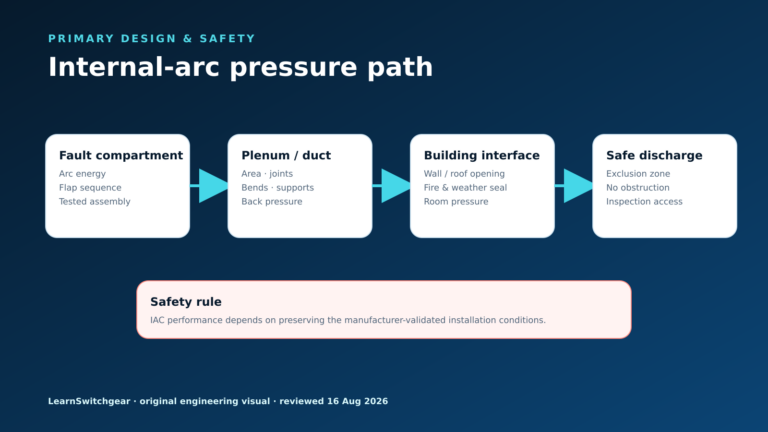
Why internal-arc performance is a system property involving the tested switchgear, installation geometry, room volume, ducting, outlets and operating access.
Fundamentals of medium-voltage switchgear: functions, ratings, equipment, configurations, insulation, internal arc performance and engineering selection.
Why internal-arc performance is a system property involving the tested switchgear, installation geometry, room volume, ducting, outlets and operating access.
Switchgear ratings are declared for specified normal service conditions. When the installation is hotter, higher, dirtier, more humid or mechanically demanding, the product may require derating, special design measures or project-specific qualification. Learning objectives Translate environmental data into insulation, thermal,…
Circuit breakers are not the only switching devices used in MV assemblies. Load-break switches, switch-fuse combinations and contactors can be technically superior for defined duties when their switching capability, endurance and protection coordination are understood. Learning objectives Choose the device…
Disconnectors and earthing switches create controlled electrical states for operation and maintenance. Their symbols can look simple, but the functions—isolating distance, current-carrying duty, induced-current switching and short-circuit making—must be specified precisely. Learning objectives Distinguish disconnection from load interruption, understand earthing-switch…
The cable compartment is one of the most underestimated parts of medium-voltage switchgear. On a single-line diagram, the interface may appear as nothing more than a line leaving a circuit breaker. In the actual panel, however, the designer must accommodate…
The protective circuit of an MV switchboard must provide a reliable path for fault current and maintain equipotential bonding of exposed conductive parts. A continuity beep is useful for workmanship, but it does not prove the thermal and mechanical duty…
Busbar reliability depends on far more than conductor size. Joints create resistance and heat, supports carry electrodynamic forces, and the enclosure changes both cooling and electromagnetic behaviour. Most field hotspots originate at interfaces rather than along uniform copper. Learning objectives…
Internal Arc Classification (IAC) records the performance of a metal-enclosed switchgear assembly during a specified internal-arc test. A complete claim includes accessibility type, accessible sides, test current and duration. The letters IAC alone do not describe the result. Learning objectives…
Partition class describes the nature of the barrier between opened accessible compartments and hazardous live parts of the main circuit. PM and PI are precise assembly classifications; they should not be used as vague synonyms for metal-clad or insulated switchgear.…
Loss of Service Continuity (LSC) categories describe how much of the main circuit may remain energised when a defined accessible high-voltage compartment is opened. They are access and continuity classifications, not universal reliability scores. Learning objectives Interpret LSC1, LSC2A and…