
End-to-End Digital Protection Commissioning: Sensor to Trip Coil
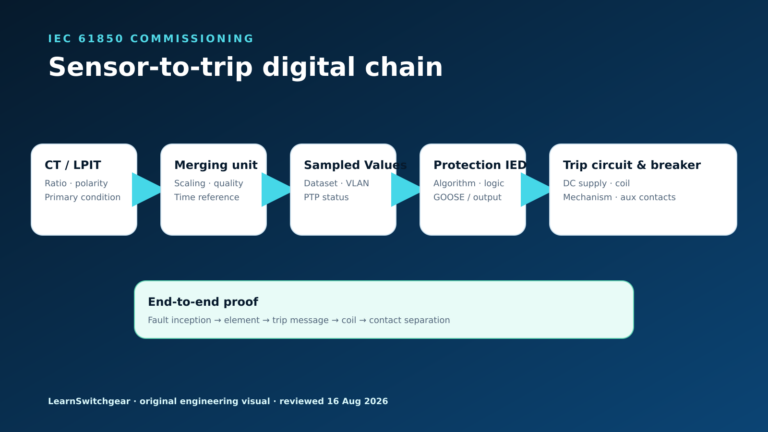
A practical commissioning method for the complete digital protection chain—from CT/LPIT and merging unit through Sampled Values, IED logic, GOOSE and the physical trip circuit.
Protection relays, CTs, VTs, LVCs, secondary circuits, trip systems, automation and communication engineering for medium-voltage switchgear.
A practical commissioning method for the complete digital protection chain—from CT/LPIT and merging unit through Sampled Values, IED logic, GOOSE and the physical trip circuit.
Automatic reclosing restores supply after transient faults by closing a tripped breaker after a defined dead time. It is valuable on overhead feeders but can be dangerous or pointless on cables, transformers, busbars and persistent equipment faults. Learning objectives Define…
Protection records transform a trip from an unexplained outage into evidence. Oscillography shows waveforms and digital states; event logs show ordered changes; setting and configuration files explain why the relay acted. Learning objectives Configure useful triggers, maintain trustworthy time and…
IEC 61850 is a system-engineering framework that combines data models, configuration language and communication services. GOOSE and Sampled Values can replace some hardwired interfaces, but they introduce network, time and configuration dependencies. Learning objectives Distinguish GOOSE and SV roles, understand…
A trip matrix is the controlled translation from detected condition to physical outputs. It identifies every breaker, lockout relay, alarm, interlock and reclose block required for each protection or control event. Learning objectives Create an auditable logic design, separate trips…
Protection coordination is the proof that the correct device clears each fault within equipment limits while healthy sections remain energised. It requires more than visually separated time-current curves. Learning objectives Build coordination cases, include measurement and breaker delays and document…
Voltage measurement can come from inductive VTs, capacitive or resistive sensors, and low-power instrument transformers. Each technology has different burden, interface, failure and test requirements. Learning objectives Select a measurement technology, design safe secondary circuits and preserve accuracy from primary…
A protection CT must reproduce fault current accurately enough for the relay to make the correct decision during the required time. Ratio and nominal burden alone do not describe transient saturation. Learning objectives Build the CT secondary circuit, calculate burden…
Trip-circuit supervision detects loss of the electrical path needed to open a breaker. It monitors a circuit condition; it does not prove that the mechanism will move or that the breaker can interrupt current. Learning objectives Choose supervision coverage for…
Breaker-failure protection operates when a trip command is issued but the assigned breaker does not clear the current or reach the required open state. It must act fast enough to limit damage yet remain secure for normal breaker clearing. Learning…